The open payment system is a system designed to bring transparency, accuracy, and accountability to payments. Mainly, CMS open payments are made among hospitals, physicians, healthcare companies, and doctors. Over the past years, the data collection and publication system has accumulated payments totaling almost $77 billion. It counts every paycheck, from small to large, to maintain financial accuracy between them. However, maintaining each and every record, pushing up the time it takes, requires a significant amount of time and effort.
These result in slow, time-consuming record maintenance, delayed responses for people, and much more. As the data expands, it becomes harder for the traditional CMS open payments model to handle and manage it. Therefore, in 2024, leaving their traditional model behind, they switched and partnered with Amazon AWS to expand their process smoothly. This guide covers how this change was significant for the system and how you, as a public health physiologist, benefit from it.
The Challenge Faced by the System in Monolithic Architecture
The original 1.0 system faced several challenges as data and detail loads increased. The problems include high ownership costs due to on-premises hosting infrastructure and maintenance that has become a burden. The traditional open payments CMS system used to follow a monolithic architecture, leading to higher maintenance costs and a poor user experience. It was characterized by frequent lags and timeouts, resulting in inflexible resource allocation that couldn’t adapt to seasonal demands. Limiting management’s capabilities in environments that hamper efficient operations. Here are a few more problems that the system faced due to the traditional setup.
- The older model incurred annual costs of approximately $4.1 million for three years.
- Costs remained high despite minimal usage (infrastructure costs).
- Commercial license fees for software further increased expenses.
- Resources were squandered during downtime (underutilization).
- Operational inefficiencies further increased costs.
Solution: With the Modernization Approach to Solve It
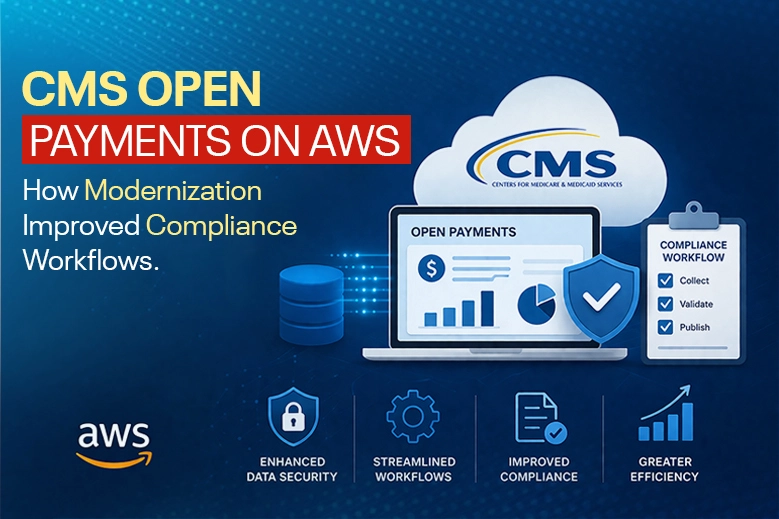
The open payments CMS was migrated to AWS to reduce costs, improve the user experience, and streamline complex processes. It turned out to be the best decision because the annual savings following the 2024 integration amount to around $3.5M. The new system has these features that make it most suitable to manage the open systems.
- The new architecture was based on cloud computing technology rather than the previous structure.
- The entire system was redesigned based on cloud principles to ensure it makes full use of cloud technologies and best practices.
- A cloud-based model helped make the system more adaptable, scalable, and cost-effective. Helping the team address the problem more effectively.
- The upgrade addressed the shortcomings of the legacy system directly.
| AWS Component | Role | Why Best Fit |
|---|---|---|
| Amazon EKS | Runs containerized microservices | Auto-scaling, flexible, reduces downtime |
| Spring Boot + Angular | Modular app design | Faster updates, better user experience |
| Amazon EMR + PySpark | Big data processing | Cuts time from days to hours |
| Amazon MSK | Real-time data streaming | Reliable ingestion, faster matching |
| CloudWatch + Splunk | Monitoring & observability | Proactive issue detection, performance insights |
| AWS CDK + CI/CD | Automated infrastructure & deployments | Consistency, speed, fewer errors |
| Cloud Architecture Overall | Foundation for modernization | 85% cost savings, scalability, improved UX |
Impact of Modernization on Compliance and Stakeholders
The modernization of CMS open payments isn’t just a technical upgrade, nor the gain of something you see only online. It directly impacts and improves how the stakeholders and compliance interact with the system. Let’s understand how:
1. Transparency and Accessibility
It made accessing data easy, simple, and smooth, making it easier for physicians, teaching hospitals, and the general public to access data faster and more reliably.
Anyone can make instant searches across millions of records without delays or lagging servers, getting results instead of reduced delays.
2. Compliance Efficiency
AWS is one of the fastest and most popular cloud platforms that provides faster upload and publication cycles. Meaning the organizations can monitor and respond to data changes in near real time if needed.
These ensure the reduced system downtime and result in smoother reporting and fewer compliance risks.
3. Stakeholder Confidence
The modernized approach makes it easy for physicians to review and dispute records before public release. Timely changes and fast responses preserve the public image.
Industry partners also benefit from streamlined submissions and reduced errors.
4. Venops Advantage
Venops is a platform that automates the screening process to deliver efficient, real-time results and helps businesses achieve accuracy. With Venops, your compliance is even more reliable, in safer hands, and with data.
Services like OIG, exclusion, screening, complaint monitoring, and tailored reporting become more efficient when built on modernized federal systems.
Venops presents itself as a bridge between CMS’s upgraded infrastructure and healthcare organizations seeking practical clinical solutions.
Concluding Here!
The transition towards a modernized CMS Open Payments illustrates the effectiveness of cloud modernization and its ability to bring tangible results. As a result of this change, the organization was able to cut its costs by 85% while increasing the speed and improving the system usability. Modernization, thus, is much more than a technological change. It is also the key to efficient management and building trust among the public.
For businesses, the message is evident: modernization leads to cost savings and reliability. Venops, being a provider of compliant solutions, makes use of the improvements and implements CMS’s data faster and more precisely into the offered services.
FAQs
What is CMS Open Payments?
CMS Open Payments is a federal program that tracks financial relationships between healthcare providers and industry.
Why did the CMS modernize the system?
The CMS modernized its system because its traditional system had many problems. Including lagging, delayed responses, costly maintenance, and a physically large architectural setup.
How does this affect a compliance platform like Venops?
It is affected by being faster and more reliable, as faster CMS data means Venops can deliver sharper compliance insights.
How can organizations benefit from this modernization and Venops support?
By combining CM’s modernized data with Venops Services, they can streamline compliance and reduce risk.