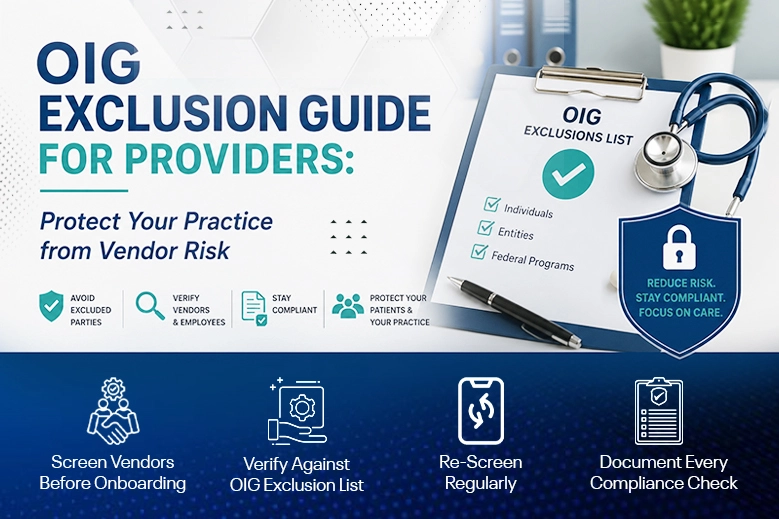
The healthcare organization deals with complex matters on a daily basis, and compliance checks are among them. Just to be safe, secure, and protected, the healthcare premises need to consistently and critically maintain OIG exclusion as a priority. Although the providers diligently work to adhere to regulations from HIPAA to the Stark Law. Still, the threat of financial devastation always lurks in plain sight from the individuals and entities you do business with every day.
An OIG exclusion is the most severe sanction imposed to confirm people’s reliability in healthcare. It confirms whether the entity is involved in healthcare and is not engaged in any illegal, fraudulent, or harmful activities. Failing to identify an excluded party in your network, whether an employee, contractor, or vendor, leads to crippling penalties.
An OIG exclusion is mandated by the Office of Inspector General (OIG) for the Department of Health and Human Services (HHS). They have the authority to exclude individuals and businesses from participating in all federal healthcare programs, including Medicare and Medicaid. Ensure to maintain it if you don’t want your organization to face penalties, reputational damages, and operational chaos. This guide breaks down the essentials of exclusions and more with a modern approach to vendor management.
Compounding Risk of Excluded Vendor Beyond the Fines
The thought that exclusion screening only results in a fine is a dangerous oversimplification. Because it’s not the screening, it’s the OIG excluded contract with the excluded vendor that creates a cascade of severe business problems. That further results in several political fines and brings chaos to healthcare operations. Here’s how the risk compounds beyond the initial fine:
1. Serious Financial Risk
This is more than just a financial penalty. The OIG can make you pay back all the money that federal agencies have used on any services provided by the OIG-excluded vendor. Such “clawbacks” can include millions of dollars from years past. Additionally, you will incur additional expenses for legal representation and audits.
2. Major Operational Disruption
After learning that you were working with such a contractor, you must end the relationship immediately. This will be especially disruptive if they perform crucial tasks for your organization, including billing, IT services, or medical equipment maintenance.
3. Damage to Your Reputation
The Destruction of Your Reputation: When news gets out that you associated yourself with an organization that has committed fraud, it can take off like wildfire. It not only destroys the reputation you’ve built with patients, referral doctors, and members of the community, but it is also very hard to repair once it is tarnished.
4. Ongoing Legal Scrutiny
The occurrence of an OIG violation often makes your organization a target for future government action. It may even result in a Corporate Integrity Agreement (CIA), which entails a period during which the government will closely monitor all of your operations.
Mandatory vs. Permissive Exclusion and the Screening Challenge
There are two types of OIG exclusions that define the OIG excluded entity.
Mandatory: mandatory due to statute for the most serious offenses (e.g., felony fraud, abuse). At least five years.
Permissive: discretionary by OIG for less serious matters (e.g., license revocation, poor quality of care, loan delinquencies). The term varies.
The table below depicts these two clearly:
| Feature | Mandatory Exclusion | Permissive Exclusion |
|---|---|---|
| Basis | Required by federal law; no OIG discretion | OIG discretion under specific authority |
| Common Offenses | Felony Medicare/Medicaid fraud, patient abuse, felony healthcare fraud, felony drug distribution | Misdemeanor healthcare fraud, license suspension, unnecessary/substandard care, defaulting on federal loans |
| Duration | Minimum 5 years, can be indefinite | No set minimum; varies by severity |
| Example | Hospital admin convicted of felony Medicare fraud → 5+ years exclusion | Therapist with suspended license → possible 3-year exclusion |
Concluding Here!
The threat that comes with a lack of OIG exclusion screening is severe, far-reaching, and persistent. Because it has long-term implications, not just a decision-making risk. With the possibility of substantial penalties and damage to your reputation, the cost of a single oversight is too great to risk. For this reason, healthcare organizations must recognize the need for a proactive strategy to continuously screen their workforce and third-party partners for inclusion on the list of excluded persons.
Manually checking or leaving it up to vendors to monitor themselves will only leave your organization vulnerable. Only through the integration of OIG exclusion screening into your vendor management system can you achieve true protection. By automatically screening your vendors and the individuals they employ against the LEIE database and others, you ensure compliance is easy and seamless. In this way, you not only prevent conducting business with an OIG-excluded individual but also create a paper trail that protects your organization in the event of an audit.
FAQs
Our vendor claims they do their own screening. Is there assurance sufficient for us?
No, it is not. While it’s a good sign that the vendor is aware of OIG compliance, the legal liability still falls on your shoulders. Therefore, makes it mandatory for every employee, vendor, or third-party entity that engages with you in any way to undergo screenings. A platform-like Venops allows you to independently validate and continuously monitor vendor compliance, ensuring your organization is safe.
Is it possible for Venops to screen all employees across our many vendors?
Manually, this is an unsustainable task. But with Venops automation services, it’s highly likely that we can integrate OIG and SAM exclusion screening directly into the onboarding and credentialing process. Our platform continuously monitors the vendor list against federal and state databases, providing alerts only when a potential match is found. Saving you countless hours of manual work.
We only work with a few major medical vendors. Do we still need automated screening?
Yes, absolutely. The risk doesn’t vary by vendor count. It’s about the impact of a single compliance failure. Because a single vendor exclusion could jeopardize millions in reimbursement. This is where an automated platform like Venops makes screening scalable, reliable, and affordable, and ensures no gaps in protection.
How does Venops simplify OIG exclusion screenings?
Venops automates vendor compliance from start to finish, including vendor screenings and key contact identification during onboarding. It uses the list, such as OIG LEIE and other sanction lists, and continuously monitors and alerts your team to any status changes.