In vendor screening, most industries still conduct an initial background check but forget to run sanction checks. Thereby, assuming that the screened vendor is completely safe to work with and do business with permanently. However, this is not true because the regulatory landscape is highly volatile, and it leaves you exposed to liability. A vendor who comes out fully compliant in January might have a chance of status in weeks, months, or by the year. It can happen as laws, sanctions, and compliance requirements change quickly. Another reason could be vendor mergers or acquisitions involving higher-risk profiles.
This resulted in the vendor being added to the sanctions lists, which requires sanctions checks to prevent significant liability. This blog explores scenarios in which one’s organization should also consider conducting regular checks on its vendors. Rather than sticking to initial or one-point screening, the exposed risk and the benefit of it with the solution.
Explore Point-in-Time vs. Continuous Monitoring
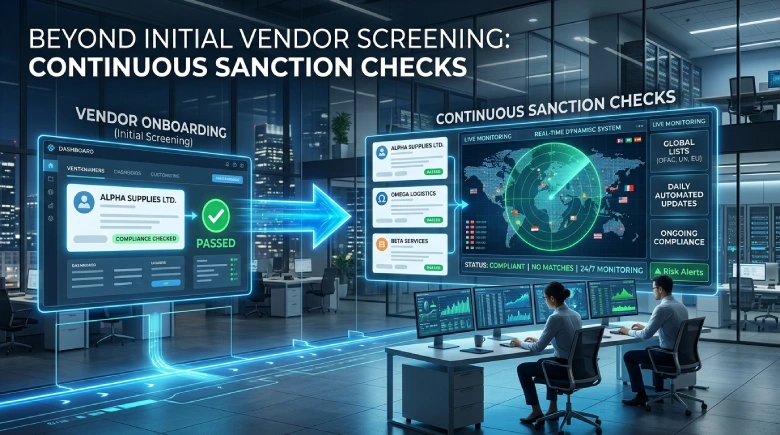
Automation is the new solution for many things as it helps us work faster, more effectively, and efficiently. Similarly, vendor compliance screening can be effective when we automate it through Venops advanced, trained software. The government databases we conduct sanctions checks against are numerous, including the OIG LEIE, OFAC, SAM.gov, state Medicaid, and many more. These are all live databases containing live documents and are updated frequently. Consequently, with each update, the risk of your vendor being added to lists increases. It is a huge blind spot in manual screening, whereas an automated solution could have flagged the potential match.
The exclusion screening is performed by an automated system as soon as the update is added to the federal databases. Additionally, the alert is also raised and updated. It is sent through email with vendor information so you can take action immediately. Let’s look at the distinguishing features of these two methods of screening.
| Feature | Point-in-Time (One-Time) Screening | Continuous Vendor Monitoring |
|---|---|---|
| Risk Exposure | High (Blind spots between checks) | Low (Real-time awareness) |
| Compliance Status | Static (Only valid on the day checked) | Dynamic (Updates with database changes) |
| Administrative Burden | Heavy (Manual searches required) | Minimal (Automated system alerts) |
| Audit Readiness | Weak (Scrambling to pull old records) | Strong (Always-on, time-stamped logs) |
Hidden Risks of the Set-It and Forget-It Approach
Automating the sanction checks and then forgetting about them is not the way to solve the compliance issue. On the contrary, not paying attention to the name that was on the watchlist can pose risks. It can mean the vendor is subject to sanctions, fraud investigations, or regulatory violations, for which you have to take reliability measures. If the vendor suddenly becomes restricted, continuing work can halt the supply chain, block financial transactions, or trigger audits. Let’s look at some tangible consequences of missing a vendor compliance screening.
1. Sudden Regulatory Fines
The financial penalties due to paying a debarred contractor are not minor or low. It imposes a significant financial burden on organizations’ budgets, as it jeopardizes funding eligibility and places the organization under immediate regulatory scrutiny.
2. Reputational Damage
Reputational damage is an additional consequence of these financial losses. The public trusts organizations, and being described as a partner to a vendor that has just been exposed for fraud or trade violations. It becomes a nightmare for PR teams and the management department, which could have prevented sanction checks. You end up losing potential clients, and the existing ones might hesitate to continue the services. Especially in healthcare, when people fear for their lives, any mistake can harm them, forcing them to discontinue and choose your competitors.
3. Operational Disruptions
Missing a vendor name from each list can leave you empty-handed when it hits, and the supply of products gets blocked. A sudden vendor exclusion results in frozen supply chains, halted technology services, or delayed healthcare operations. Exclusion screening could have prevented all this, as these vendors provide critical inputs that ensure continued operations in workplaces. Losing them overnight can derail entire workplaces, stopping work and causing loss.
4. Ownership Changes
Ownership changes often lead to some situations; when a vendor is acquired, they may inherit new executives or stakeholders. These people might already be on the government watchlist, and acquiring a vendor also immediately adds to these risks upon inheritance. Exposing your organization to complicated violations if not caught in time.
Wrapping It Up!
The organization’s protection needs to be achieved through continuous sanction checks rather than treating it as a one-off onboarding risk. The blog already explores the major differences and risks between point-in-time and continuous monitoring. It is also imperative never to ignore the addition of a vendor to a watchlist, as it can disrupt organizational operations and cause significant losses. Treat every vendor’s compliance check as a major duty and maintain the organization’s continuous momentum.
It’s high time to upgrade your manual process to an automated one, even if you think your team can manage it all. Big or small, any organization has to conduct sanction checks on vendors, employees, and everyone related to the organization. If you want to upgrade to Venops today, only. In no time, we can automate your system, save you time, and deliver a secure, error-free compliance check.
FAQs
What could be a possible reason for a vendor status change after initial onboarding?
These can change for multiple reasons, including committing fraud, failing regulatory audits, or violating trade laws. These all reasons can immediately result in the vendor status being changed into a restricted government watchlist. Furthermore, without exclusions screening, you can also face sudden legal actions and final penalties.
How often should an organization screen its third-party vendors?
To be on the safe side, the best practice is to have continuous, real-time monitoring rather than annual checks. Automation tracks daily and provides live updates, and completely eliminates any blind spots and penalties.
Can Venops seamlessly track multiple government databases simultaneously?
Yes, our platform offers continuous monitoring across federal, state, and international databases. We run exclusions screening continuously to ensure you are always protected from complex regulatory blind spots.
Does Venops provide verifiable proof of compliance for audit purposes?
Absolutely. Our system automatically generates and secures store details and time-stamped reports for every search.