Vendor background checks and screening are continuous processes that include verifying vendors’ integrity against multiple sanction lists maintained by government and semi-government bodies. Vendor screening ensures that you only work with well-qualified vendors that can provide on-time services and also have clean financial and criminal backgrounds. Moreover, the healthcare industry requires a stricter screening process due to the complex compliance regulations surrounding the industry.
Therefore, screening vendors in the healthcare sector is not just about hiring the right vendors, but also about avoiding legal action and prohibition from state-funded healthcare programs. In this blog, we will cover the steps involved in the vendor screening process to give you a clear idea of how the process works. As a result, it will allow you to avoid financial penalties and ensure high-quality healthcare services.
Steps Involved in the Vendor Screening Process and Their Significance
It is crucial that both the vendors who are already working with the healthcare organization and the vendors who are in the pipeline go through the stringent process of screening. Moreover, to ensure accuracy and to comply with the complex legislation involved, the screening process is undertaken in several steps. The following are the steps in the screening process and their importance:
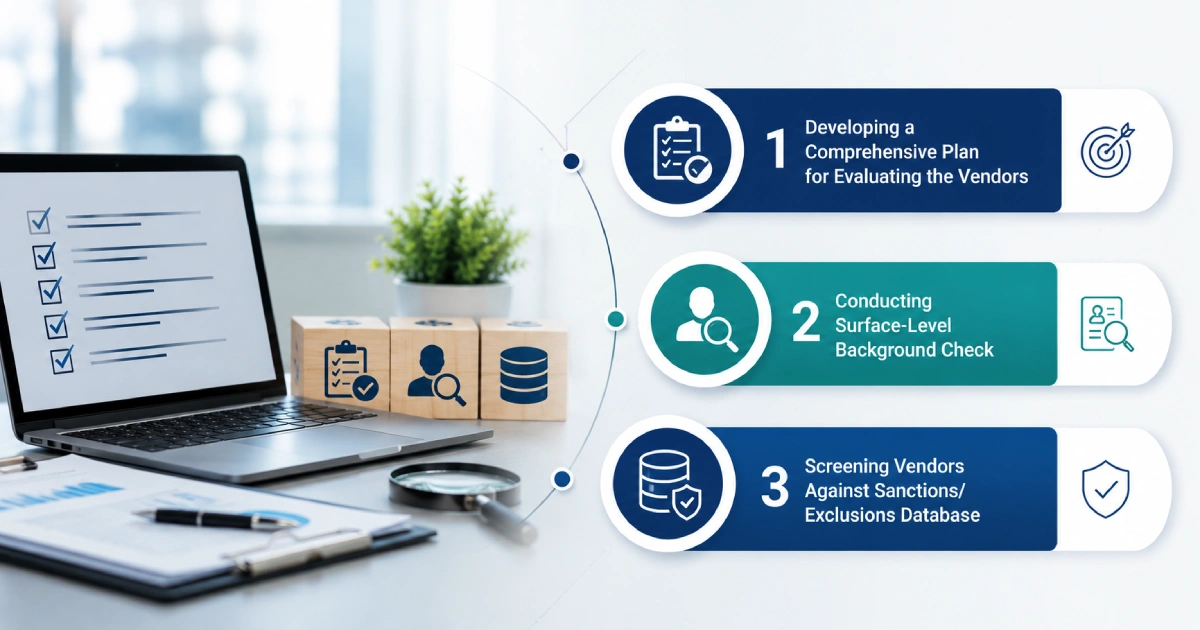
1. Developing a Comprehensive Plan for Evaluating the Vendors
As the first step in the vendor screening process, it is important to develop an overall evaluation plan for the vendors. It has to be based upon compliance needs, organizational needs, and risk tolerance level. It is also important to note that these evaluation criteria should remain constant for all the vendors, except for some selected vendors. During this phase of the evaluation process, vendors have to prove their legal status, financial standing, certifications, operational capability, and regulatory compliance. All the information received during the evaluation is thoroughly examined by the organization or the third-party compliance service provider.
2. Conducting Surface-Level Background Check
This step is undertaken by conducting a background check of the vendors to gather surface-level information before performing the exclusion screening /sanction screening status. This involves examining the performance record and criminal record of the vendors. The surface-level check saves the healthcare organization from wasting time and resources on vendors having a high-risk profile.
3. Screening Vendors Against Sanctions/Exclusions Database
This step follows the initial background check to verify whether the vendor has been screened against sanctions and exclusion lists. It confirms that they have been legally screened to offer their services/goods to the organization. Moreover, this prevents any sort of financial penalties. This process of vendor screening includes prominent databases such as SAM, OIG and many more.
Final Evaluation Based on Previous Screening
The collected information from the process mentioned above is used to analyze the vendor’s risk level as well. Financial status, compliance with cybersecurity, past experience, ability to perform the work, and reputation are taken into account for determining if the vendor poses a low, medium, or high risk.
Government Sanction List Used for Screening
| Database | What It Screens | Used For | Recommended Screening Frequency |
|---|---|---|---|
| OIG LEIE (List of Excluded Individuals and Entities) | Individuals and entities excluded from Medicare, Medicaid, and other federal healthcare programs | Mandatory healthcare exclusion screening | Monthly (Office of Inspector General) |
| SAM (System for Award Management) | Federal debarments, suspensions, exclusions, and ineligible contractors | Federal contracting and healthcare vendor due diligence | Monthly or before engagement (Office of Inspector General) |
| State Medicaid Exclusion Lists | Providers and vendors excluded from state Medicaid programs | State-specific compliance requirements | Monthly (Office of Inspector General) |
| OFAC Sanctions List (SDN & Consolidated Lists) | Sanctioned individuals, organizations, countries, and blocked entities | Financial crime, AML, and international vendor screening | Continuous or monthly |
| FDA Debarment List | Individuals and companies prohibited from participating in FDA-regulated activities | Pharmaceutical, biotechnology, and medical device vendors | Quarterly or before contracting |
| DEA Registration Validation | DEA registrations and controlled substance authorization | Pharmaceutical distributors, pharmacies, and controlled substance suppliers | During onboarding and renewal |
Concluding Note from Venops
Vendor screening is critical for maintaining compliance regulations, reducing operational risks, and ensuring high standards of patient care in the healthcare sector. Healthcare organizations depend on third-party vendors for essential products and services. Hence, partnering with an unqualified or sanctioned vendor can lead to civil monetary penalties, financial losses, and damage to reputation. Healthcare organizations working with sanctioned or excluded vendors are liable for heavy CMP, exclusion from state-funded federal programs, and financial fines.
Partnering with experienced third-party screening providers further improves the accuracy and efficiency of the process through automated checks and real-time monitoring. More importantly, effective vendor screening not only protects the organization from unnecessary risks but also strengthens supply chain reliability, supports regulatory compliance, and contributes to the delivery of safe and high-quality healthcare services.
FAQs
What are the risks of non-compliance with legal regulations in the healthcare sector?
Not meeting the compliance regulations leads to the following risks:
- Can lead to significant financial penalties and regulatory fines.
- May result in license suspension or exclusion from government healthcare programs.
- Damages the organization’s reputation and patient trust.
- Increases the risk of lawsuits, investigations, and operational disruptions.
Why is vendor screening important for healthcare organizations?
It helps organizations avoid working with sanctioned or high-risk vendors, maintain regulatory compliance, reduce financial and reputational risks, and protect patient safety. It also has a significant impact on the organization’s reputation and ensures patients receive high-quality treatment.
Which sanction lists are commonly used for vendor screening?
Healthcare organizations commonly screen vendors against databases such as the OIG LEIE, OFAC SDN List, SAM Exclusions, United Nations Sanctions List, and other applicable national or international watchlists. Each sanction list covers a different legal route and thus, compliance with all the major sanctions lists is mandatory for healthcare organizations.
How often should vendors be screened?
Vendor screening should be performed before onboarding and repeated periodically through continuous monitoring, especially when sanctions lists or regulatory requirements are updated. Experts suggest performing the screening every month, as most sanction/exclusion lists are updated monthly.
Why should I outsource vendor screening services from Venops?
Outsourcing vendor screening services from Venops offers the following benefits:
- Receive accurate and compliant vendor verification using up-to-date regulatory databases.
- We reduce compliance risks through comprehensive sanctions and exclusion list screening.
- The screening process is quick, and the vendor onboarding includes automated and standardized screening processes.
- Provides continuous monitoring to identify emerging risks and maintain ongoing compliance.