In the highly competitive and lucrative world of healthcare, exclusion screening is the compliance check. That isn’t just a requirement to be ticked off your list of things to do during onboarding of an employee. But a vital layer of protection against CMPs worth millions of dollars. While most executives in the healthcare industry understand the importance of performing an extensive background check on their workers and vendors. The ways they do it greatly differ from one facility to another.
Sadly, many facilities resort to the old-fashioned method of performing checks manually, which makes them very susceptible to the problems arising. From non-compliance with the standards that would have been avoided with exclusion screening if it were done in the first place. In order to fully protect a healthcare organization from the risks associated with non-compliance, its leaders should move forward. By going beyond a minimal approach to the issue and learning what distinguishes the best automated screening software from others. This will help you reduce the risk, save time, and ensure the constant work of your facility without interruptions.
Why the “Must-Have” Rule Outgrew Manual Methods
The Office of Inspector General (OIG) has made it crystal clear that healthcare organizations must conduct exclusions screening. To avoid healthcare organizations have employees and doing business with any excluded persons or entities. Violations of these rules can cost them thousands of dollars as a penalty of up to $20,000 for each item or service billed. However, in spite of this huge financial risk, a lot of organizations still try to handle their compliance via manual spreadsheet or database search. Below is the list of 4 hidden risks in using old-fashioned methods of exclusion screening:
1. The Frequency Failure
Many organizations tend to screen their staff when they are hired or once a year. But there are constant updates of exclusion lists, and annual checks violate the OIG’s recommendation about monthly monitoring, with a huge gap of non-compliance throughout 11 months.
2. The False Positive Risk
Manual exclusions screening poses a serious headache for HR managers. Checking common names like “John Smith” or “Maria Garcia” will give dozens of false positives, and manually checking secondary information for each of them is very time-consuming.
3. Human Error
Managing numerous employees and vendors with spreadsheets can be messy. Mistakes like missed cells, typos, and uncontrolled contractors can easily result in devastating federal fines.
4. State-Level Blind Spots
A major pitfall of basic compliance is only checking the federal OIG List of Excluded Individuals/Entities (LEIE). This completely ignores the 42+ fragmented state Medicaid exclusion screening lists, leaving organizations blind to localized compliance risks.
5. The Missing Audit Trail
Managing compliance via manual spreadsheets leaves organizations without verifiable, historical proof of their efforts. If state or federal auditors request documentation, presenting an easily alterable Excel file is a massive liability; organizations need secure, time-stamped evidence of their monthly screens that manual methods simply cannot guarantee.
What Makes a Screening Service “Top-Tier”?
With the increasing complexity and risks related to healthcare compliance, a variety of advanced SaaS systems have been developed. However, not all the software created is equal and works accurately to the point.
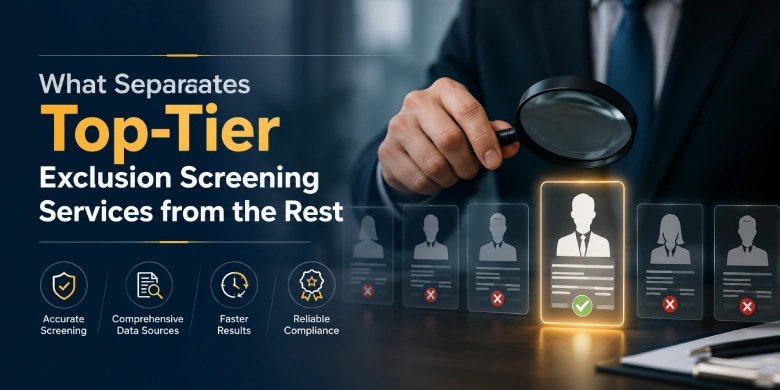
The best screening services, such as Venops, do not just automate the process but make it completely different. By using complex data, automatically repetitive tasks, and providing impenetrable audit trails, elite platforms stand head and shoulders above basic compliance tools. Here is the table below that lets you understand what separate top-tiers solutions from basic methods
| Feature Category | Manual Compliance Methods | Top-Tier Screening Services |
|---|---|---|
| Data Scope | Searches only the federal OIG LEIE. | Searches OIG, SAM.gov, and all 42+ State Medicaid lists. |
| Frequency | Conducted annually or upon initial hire. | Automated, continuous monthly monitoring and alerting. |
| Verification | HR manually researches and clears name matches. | Advanced algorithms automatically resolve false positives. |
| Record Keeping | Static spreadsheets; easily corrupted or lost data. | Secure, time-stamped, and audit-ready digital dashboards. |
Final Thoughts!
The current regulatory not-attempting exclusion screening makes non-compliance both risky and costly, especially to healthcare organizations, as one blow takes years of reputation. There’s just too much on the line to continue operating under the outdated assumption that exclusion screening is just a yearly administrative task.
By moving away from a manual approach and embracing a premier automated service, you’ll be ensuring the success of your organization in an era when non-compliance could be devastating. Choosing a full-service solution such as Venops will allow you to make sure that you won’t face any issues related to human error or gaps at the state level. Make sure that you choose a premier exclusion screening provider.
FAQs
Why is checking the OIG LEIE alone inadequate?
Checking the OIG LEIE alone is far too inadequate due to several huge blind spots. First-rate compliance demands cross-referencing SAM.gov and all 42 State Medicaid exclusion lists in order to evade hefty fines and ensure full organizational safety.
How frequently should exclusion screening be performed by healthcare organizations?
Healthcare organizations should perform routine exclusion screening of all their employees, contractors, and vendors every month without exception. Monthly exclusion screening will help you avoid any possible compliance gaps that can land your facility Civil Monetary Penalties.
What happens when there is an error in someone’s name during exclusion screening?
Venops uses advanced algorithms for name matches and secondary identifiers to automatically remove any false positives. Therefore, your HR staff will never have to do manual reviews because only real matches will reach your team.
Is Venops compatible with my current HR software?
Yes, Venops provides secure API integration specially developed for enterprises in healthcare. Thanks to this option, data exchange between your HR software and monthly compliance screening dashboard will become fully automated.
Do I get audit-ready reports with Venops?
Yes, Venops automatically generates and stores time-stamped, audit-ready compliance reports. If inspectors request documentation, you can instantly export your complete screening history, proving your organization’s continuous regulatory compliance with ease.