Most healthcare organizations believe and follow the idea that if a vendor isn’t on the federal blacklist. It means they are safe to hire or work with. However, the background checks need to go beyond that, as the standard check should now include CMS open payments. In today’s regulatory environment, avoiding criminal actors is the bare minimum, as the new standard requires avoiding conflicts of interest (COI). For that reason, one needs to move beyond simple exclusion checks and follow the Sunshine Act seriously, starting from their onboarding phase. So that the organization’s safety is maintained and the workplace is protected.
Checking your vendors or physicians against the exclusion list is a legal requirement, but using open payments system data is a strategic necessity. Moreover, this CMS open payments guide explores why it’s a new standard for vendor vetting and maintaining transparency.
Three Warning Signs Hidden in Open Payments Data
Using Open Payments CMS data as a compliance resource can be really handy for an organization to maintain compliance. As it will flag a warning about potential physicians or vendors you’re going to work with. Allowing you time to keep a close eye on or think about your partnership deal ahead of time. Let’s look at some concerning signs.
1. The Captive Key Opinion Leader (KOLI)
Open payment systems include all transactions made by organizations for physicians’ services. It includes every small detail from lunch to vacation, to financial payments, everything. Checking it before for any entity you can be aware of in scenarios where physicians received overwhelming funding from a single pharmaceutical company. Although this doesn’t make them OIG Excluded, it does introduce bias that your organizations need to be aware of before engagement.
2. The Sudden Spike in Payments
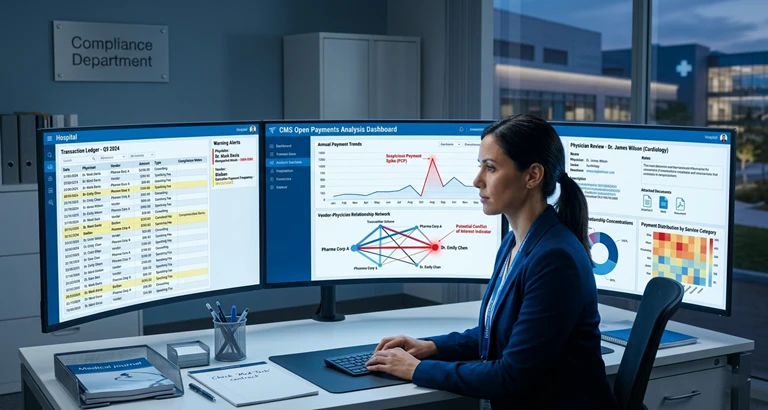
The sudden increase in vendor payments can raise suspicions among federal bodies, prompting investigations into vendors. Large or sudden payments are made only to hide a mistake or to bribe vendors. Therefore, it is considered a questionable practice, and regulators, upon seeing this payment trend, decide to investigate. A vendor receiving disproportionate payments compared to peers may be scrutinized for fraud, bribery, or conflicts of interest. Upon seeing such a trend in open payments CMS, organizations can be alerted, preventing them from fines, sanctions, or operational disruptions.
3. Conflicting Ownership Stakes
CMS open payments can actually disclose many things simply by monitoring vendors or physicians once. One such is that this payment data reveals the ownership and investment interests of the vendor you’re buying resources from. Their investment interests can reveal whether they have a financial stake in the products they are advising your hospital to purchase. So you can be aware and avoid purchasing the equipment and medicines that are not up to the mark.
The Legal vs The Ethical Fit: Advanced Safety Measure
The phrase “the more the merrier” portrays the perfect example of a situation. The more checks we go through, the more rigid our system will be, leaving no room for compliance mistakes. With these double checks, we can get the OIG excluded entity identified early on. It’s not only to ensure a basic background check but also to catch what financial transparency data catches.
| Feature | The Standard Background Check (OIG/SAM) | The Strategic Financial Check (Open Payments) |
|---|---|---|
| Primary Data Source | OIG Exclusion List (LEIE) & SAM.gov | CMS Open Payments Database |
| What it Reveals | Fraud, felonies, and license revocations. | Consulting fees, gifts, grants, and ownership stakes. |
| The “Red Flag” | The provider is legally banned from billing Medicare. | The provider has heavy financial ties to a competitor. |
| Timing | Often checked only at hire/monthly. | Usually checked only retrospectively for reporting. |
| Risk Mitigated | Federal fines and civil liability. | Reputational damage and Conflict of Interest. |
The vendor with an OIG Exclusion might clear the list during the traditional screening process across many federal checks. However, Open Payments can create complexities for them, as it entails deep financial scrutiny. Such as monitoring payments, ownership structures, or entanglements with high-risk entities. The vendor might come clean in the traditional check, but the open system shows their upcoming months. Through their recent activities or moves, they ended up failing if their finances introduced conflicts of interest, excessive ties, or suspicious transactions.
Concluding Here!
Modern Complaints covers a holistic view of a vendor, not just the basic ground of not being excluded. CMS Open Payments is one of those resources that helps us identify such vendors in advance or gives a heads-up. So we can closely monitor their upcoming financial transactions and stay ahead in preventing any penalties or fines. However, when checking these databases alone, we have to go through many compliance lists before partnering with any vendors or physicians. If the open payments list grows, it would take a week just to perform a basic check, let alone for continuous monitoring.
CMS Open Payments checks, along with compliance checks, can be better monitored and done through automatic systems. Such large-scale databases are impossible to go through manually, but with automation, they can be processed in minutes. Besides, you will have full accuracy with no compliance gap. If you agree, look no further than Venops, an automated software that does your work in minutes.
FAQs
Q 1. Why should I review open payments data if the vendor is not excluded?
Ans: Reviewing this data reveals financial conflicts that are missed in compliance checks. Therefore, checking before working or partnering with a vendor can protect the organization.
Q 2. What is the main difference between an OIG exclusion and a reported open payment?
Ans: An exclusion screening prevents providers from receiving deferral funding due to fraud or misconduct. On the contrary, open payments reflect transparency by tracking financial relationships.
Q 3. How does Venps streamline verification processes?
Ans: Venops centralizes your compliance efforts by automating your vendor data management through cross-referencing with federal databases.
Q 4. Does Venops monitor state-level disciplinary boards in addition to federal lists?
Ans: Yes, beyond federal databases, our platform aggregates data from thousands of state-level sources and disciplinary boards to comprehensively create a safety net.
Q 5. How quickly can Venops implement screening for our staff?
Ans: Implementation of the screening process is rapid using Venops’ fast automated software. Once you upload your provider list, our system performs immediate screening. You receive actionable reports with highlighted potential matches or exclusion status instantly. These allow your compliance team to mitigate risks without disrupting your daily operations or workflows.