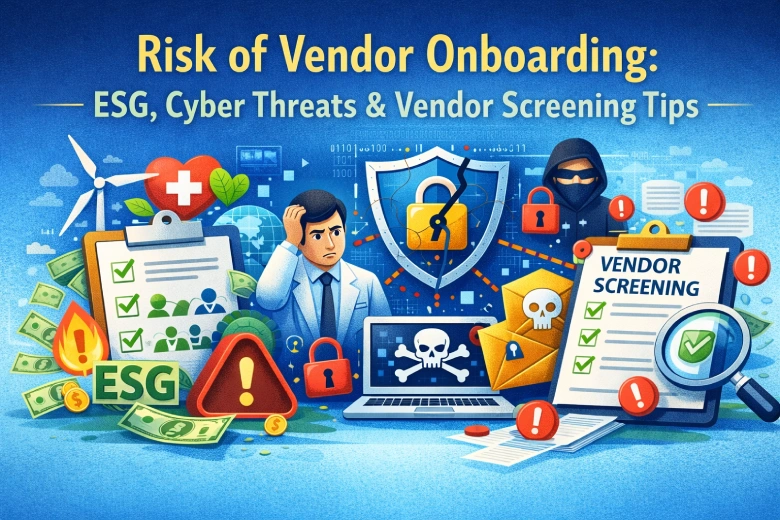
Getting healthcare treatment isn’t just about price and quality nowadays, but it also encompasses safety, ethics, and data security. Therefore, knowing that vendor screening has been completed for the vendor supplying medicine or medical equipment puts the individual at ease. It also represents healthcare facilities committed to delivering proper care with high-quality service. Reliance on doctors and staff for treatment is vital to life and safety, so before choosing a healthcare provider, check their reputation.
Unfortunately, many healthcare organizations still rely on traditional, siloed onboarding methods. Their compliance teams may manually check the exclusion list, while IT security sends disconnected questionnaires, and sustainability metrics are often ignored entirely. This lack of proper connection in vendor screening creates significant gaps that allow data breaches, regulatory fines, and supply chain disruptions to slip through. In this blog, we will explore how one organization can protect itself to become the top choice for patients.
Protect Healthcare Facilities With Triple Layer Check
To better protect patients and maintain trust, leaders must pivot to a holistic “Triple Check.” Meaning blending the three main components: ESG, Social, and Governance (ESG) criteria, with a rigorous cyber resilience and instant exclusion screening. The healthcare system just needs to build a supply chain that is not only compliant today but also strong enough to protect against the threat of tomorrow.
Just by doing this, the organization can prove itself to be the number one organization that prioritizes people’s security. Maintains data information for safety and security with multiple checks that are far beyond any background and rough manual checks.
Integrating ESG, Cyber, And Exclusion Screening
Effective vendor screening is no longer about checking a single box. It is about managing a complex web of risks through a centralized “command center.” To secure a future-proof model, many organizations are moving toward integrated automated models that provide regulatory checks and enforce strict credentialing standards. To maintain digital and environmental safety. Here are the two main components that provide protection.
1. Regulatory Foundation (Automated Compliance Checks)
The basis of vendor screening is to ensure that your healthcare organization is not partnering with any sanctioned entities that could expose it to risk. Manual monthly checks leave a dangerous 30-day gap period where excluded vendors might slip through. By implementing automated vendor screening software, an organization can cross-reference suppliers against OIG, SAM, and state Medicaid lists in real time. It always monitors the list and alerts instantly if any vendor’s status changes, ensuring your compliance never sleeps.
2. Credentialing Gatekeeping (Cyber & ESG Verification)
While you cannot physically inspect every vendor’s factory and firewall, you can use a robust credentialing platform to enforce accountability. With one platform that will centralize the system and require vendors to upload their proof of resilience. Including SOC 2 cybersecurity certification or ESG sustainability policies before any vendor can be onboarded or partnered with. The transform and advanced system ensures vendor screening transforms from a passive administrative task into an active gatekeeper. Ensuring only eligible partners who meet our security specifications and ethical standards are granted access to your network and supply chain.
Traditional Onboarding Vs. Future Proof Onboarding Approach
Advanced Vendor Screening has evolved far beyond traditional basic background checks. These advanced checks have significantly reduced fraud and fines, and exposed healthcare facilities to reputational risk. Making the healthcare organization safer and more secure. Here are the differences between these two approaches based on the five criteria that underpinned today’s check as security proof.
| Screening Factor | Basic Background Check | Advanced Vendor Screening |
|---|---|---|
| Risk Scope | Reviews financial history and standard legal terms in isolation. | Integrates ESG impact, cyber posture, and regulatory compliance into a unified risk profile. |
| Frequency | Occurs once at contract signing, leaving long periods of unmonitored risk. | Utilizes continuous monitoring, triggering alerts immediately if a vendor’s screening status changes. |
| Cyber Risks | Accepts unverified self-assessments or basic questionnaires. | Validates digital defenses using real-time security ratings and external vulnerability scans. |
| Exclusions | Manual monthly batch checks create 30-day compliance gaps. | Automated screening cross-references OIG/SAM lists instantly to ensure zero tolerance. |
| ESG Integration | Often skipped entirely. | Makes sustainability a mandatory screening metric to filter out unethical suppliers early. |
Summing It Up!
To position your healthcare facilities as the safe, sound, and top service provider, vendor screening is one of the priorities. Anytop services are provided only with high-quality, certified materials or medications, which are available only when the vendor is certified and has a clean background. It is primarily a safety measure to conduct frequent vendor checks to ensure they are safe and not excluded by the federal government. While doing this check manually, they are prone to human error.
With Vnops, these services can be automated, relieving pressure and enabling vendor screening checks to run on a frequent basis without missing a month. It can check all the lists, including LELE OIG, SAM.gov, and more. Get automated with us from today only! Our U.S. based team is available to contact anytime with any queries. Your work is not delayed, and you won’t miss any checks.
FAQs
Why should ESG be a part of the standard vendor screening process?
Integrating the ESG system into your screening process helps predict long-term reliability. Vendors with poor governance or environmental records are more likely to face lawsuits or shutdowns. That could pose a direct risk to your supply chain stability. Therefore, to secure early protection and long-term eligibility, it is essential to integrate an ESG system into your screening process.
Is monthly vendor screening for exclusions sufficient for compliance?
No. The federal exclusion list can be updated within a day or over weeks, while the monthly screening leaves a 29-day window. In this case, the exclusion list can add the need for a vendor to be reviewed on the next screening step, resulting in unwanted fines or charges. Therefore, it is recommended to automate the screening process with Venops. That will move you from manual checks to continuous daily monitoring to close compliance gaps.
How does Venops help with cybersecurity screening?
While we don’t perform the technical hacks, our credentialing platform allows you to obtain security certifications such as ISO 27001 or SOC 2. As with a mandatory upload field, this ensures no vendor is onboarded until they prove their digital defense standards. This is how Venops, as a trusted platform, keeps your healthcare facilities safe from any vendor that is not certified to work with you.
Can we automate the vendor screening process entirely?
With Venops, you can automate the heavy-lifting tasks. Venops automatically cross-references sanctions lists (OIG/SAM) and tracks the expiration dates of uploaded documents, such as insurance policies or ESG certificates. Additionally, our system alerts only when an issue requires human attention.
What is the ROI of investing in vendor screening software?
The Return Of Investment (ROI) is driven by risk avoidance and efficiency delivered in the work. You eliminate the labour costs of manual checks and, importantly, prevent the massive federal fines associated with inadvertently paying an excluded vendor.