Imagine a hiring manager sees a candidate who was excluded five years ago for a five-year term. The most common response is that the candidate is now safe to hire and okay to work with. However, these fall within the risk zone and expose the hiring organization to liability. The exclusions list OIG doesn’t automatically reinstate the individual, allowing them to work after a specified probation period. It is an offline process in which an individual must apply manually and obtain approval from OIG. Before doing anything, candidates are still considered to be on the excluded list, and hiring them would be a dangerous mistake.
These are unlike standard prison sentences or a license suspension that might expire on a specific date, as they are indefinite. Just checking the dates isn’t enough. An excluded individual’s name remains on the exclusions list OIG until the specific action is taken to remove it. Therefore, this will be your guide to clarify why the expiration time doesn’t mean that you’re cleared to work in the industry. It will also help an organization protect itself from this compliance blind spot.
Common Misconception About Auto-Reinstatement & Cause
Many HR professionals and credentialing managers operate under a dangerous assumption. They don’t conduct an OIG check, believing an OIG exclusion time-out on their own, and an individual is safe to work with again. However, this is far from the truth and the rules set by federal bodies.
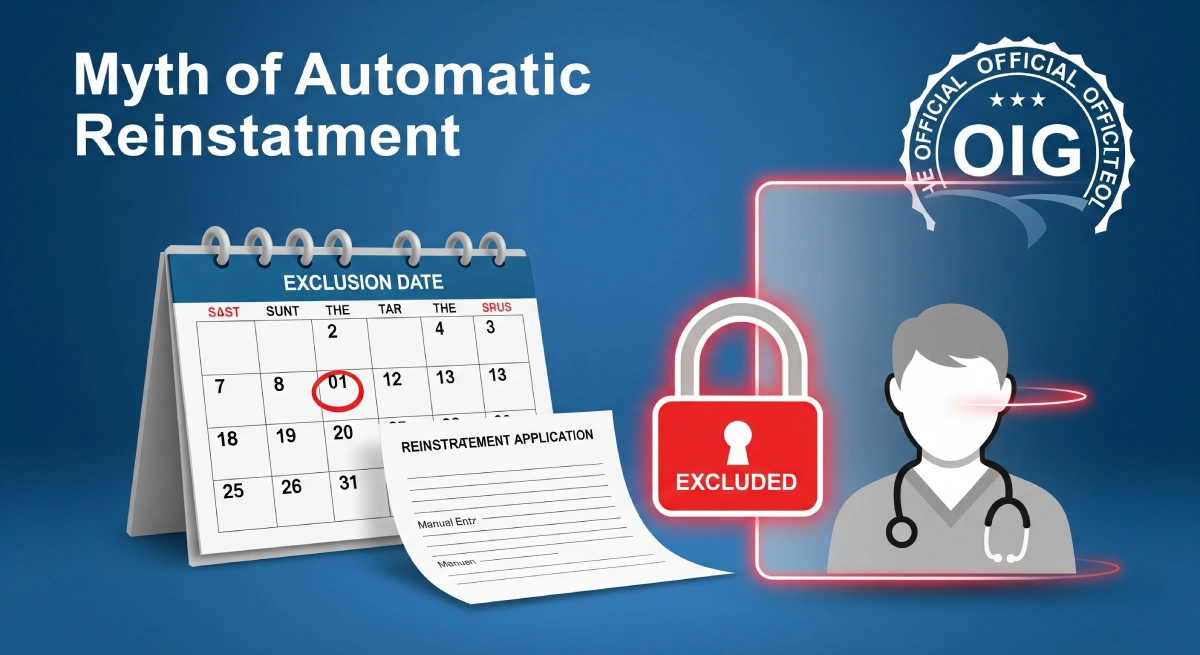
Auto-reinstatement is a common myth and mistake that has lingered in people’s and hiring managers’ minds for a long time. The OIG (Office of Inspector General ) doesn’t work this way. They don’t have their list and exclusion timer automatically running. If an individual is nearing the end of their exclusion period, they must submit a manual request to have their name removed from the list. The process takes up to 90 days and asks individuals to apply when only a few days remain in their exclusion period. Failing to do this means their name remains on the list and they remain restricted from working with any organization.
The OIG Excluded individual status is restricted, unlike a driver’s license suspension, which may be lifted automatically after a set period. An excluded entity remains on the list until it successfully petitions for reinstatement and receives official approval. In this case, the “Exclusion Period” is the minimum time the provider must wait before they can apply to have their license reinstated. It is not an expiration date. Therefore, it is mandatory to go through the reinstatement process.
In such a matter, the organization that relies on manual tracking comes at risk. By reviewing the candidate’s file, it is clear that they have completed their penalty term and are eligible to work. However, a proper review will reveal that they remain legally barred from participating in federal healthcare programs. Until OG physically removes the name from the database, the ban remains active, and the risk to organizations persists.
Risk of Hiring an Individual With Expired Exclusions
If you, as an organization, employ an individual and bill for their services under a federal health program. You are liable for severe Civil Monetary Penalties (CMPs). The OIG check and the removal of the individual’s name from the federal government database are crucial to confirming their eligibility to return to work. As the OIG places the burden on the employer to verify the employee’s status and their claim to be free. That my time is up is not a valid legal defense, and a manual letter of approval from OIG is required.
Additionally, it is crucial to hire only after the OIG manual removes the name from the exclusion database. To prevent you from being exposed to penalties. It is compulsory in healthcare facilities to run a thorough screening to identify OIG excluded entities. Relying on self-disclosure is risky, and relying on love database verification is secure, which you get only with Venops.
Final Words!
Exclusion of any individual doesn’t end until OIG says it. For a large organization, manually tracking reinstatements is extremely risky. The exclusions list OIG maintains the entity’s name until it grants manual approval to the individual. The process takes up to 90 days, and missing the deadline is not an option. Because you will be restricted from working, and, as for the organization, you will be liable for heavy penalties. If you employ such an individual.
Therefore, adopt a modern approach and use the Venops automated process for such complex and risky tasks. With a fast, deep-rooted algorithm, our system delivers accurate results, rapid checks, and 100% accurate screening. Screening through the Exclusions list OIG becomes quick and effective if you sign up with Venops. Sign up today to automate the process that doesn’t make assumptions based on dates. It verifies the actual status.
FAQs
Q 1. Does the OIG automatically remove names once the exclusion period ends?
Ans: No. An individual remains on the excluded list until they receive an official notice of reinstatement from the OIG. Even if the penalty term has passed. The OIG check will still place them on the exclusion list, and any organization cannot hire them until the administrative process is complete.
Q 2. How does Venops help with providers who claim their exclusion is over?
Ans: Venops is an automated software that runs a continuous OIG check against the LEIE. Because our software verifies the actual database’s status rather than relying on the candidate’s words or calendar dates. Our fast and automated check prevents you from hiring candidates who have not yet petitioned for reinstatement.
Q 3. Can we bill providers with pending reinstatement for services?
Ans: No. If a provider remains on the exclusion list, they are prohibited from making any service payments under a federal health care program. You must wait until their names are officially removed before boiling, or your organization risks severe Civil Monetary Penalties.
Q 4. What databases does the Venops platform monitor monthly?
Ans: Beyond the federal exclusion list, Venops monitors the list against GSA, SAM.gov, state Medicaid exclusion lists, and other disciplinary sources. Our comprehensive screening scores many data points to ensure no match is left, and you are in safe hands. Therefore, your safety is ensured across jurisdictions, protecting your revenue from complex compliance gaps and multi-state risks.
Q 5. How quickly can Venops implement screening for our staff?
Ans: Implementation of the screening process is rapid using Venops’ fast automated software. Once you upload your provider list, our system performs immediate screening. You receive actionable reports with highlighted potential matches or exclusion status instantly. These allow your compliance team to mitigate risks without disrupting your daily operations or workflows.