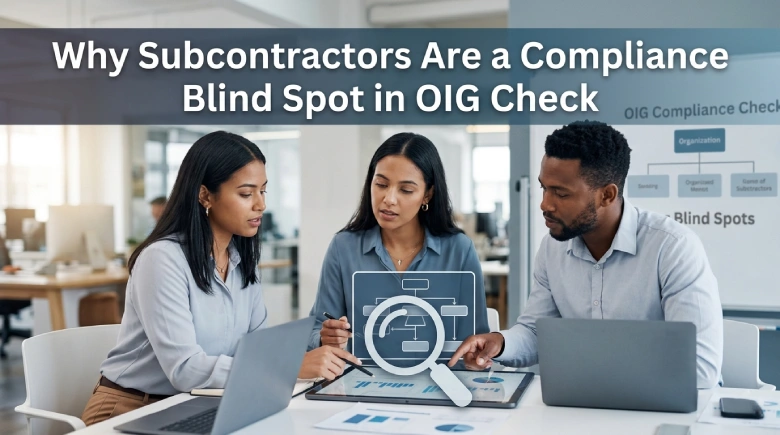
A major hospital system with extensive market presence and lifelong expertise in its field passed every audit. However, the lack of an OIG check on subcontractors led to a $2.3 million fine. The subcontractor has an excluded employee, whom the hospital had never heard of before. Yet somehow the liability falls on the hospital, resulting in a fine and reputational damage. These shadow vendors pose the biggest risk to big organizations. They can be subcontractors, fourth-party vendors, or even indirect service providers. Therefore, conducting thorough screening on each individual you engage with is essential to protect and maintain the reputation.
However, a manual OIG check can take a long time and be a lengthy process. That can be a waste of precious time in a hospital environment, where even seconds matter. Healthcare organizations focus on Tier 1 vendors, while ignoring Tier 2 and Tier 3 risks. These subtle errors lead to OIG fines, Medicare and Medicaid payment suspensions, and organizations losing patient trust. Remember that your vendor compliance screening is only as strong as your weakest subcontractor.
How Shadow Vendors Slip Through the Cracks?
The most dangerous risks are the ones that fall upon us when we don’t know they exist. The same goes for compliance risks: when we don’t know from where the fine or penalty can be charged, it’s hard to fix. Do not make the mistake of investing heavily in credentialing direct vendors while leaving an entire ecosystem of subcontractors operating beneath them. Unscreened, unmonitored, and often unknown until it’s too late. Understanding how shadow vendors evade the traditional OIG Screening process is the first step towards closing the gap.
The three tiers of Vendor risks involve:
1. Tier 1 Vendors: The Ones You Know
Tier 1 covers the vendors’ organizations that focus the most. It’s the direct contracted partners of organizations such as medical staffing agencies, IT Vendors, and facilities management. The entities are screened properly, fall under contract compliance, are regularly audited, and are monitored. However, the OIG check on tier 1 vendors doesn’t guarantee that their subcontractors are clean or not excluded by OIG.
2. Tier 2 Vendors: The Ones You Don’t See
The Tier 2 vendors consist of entities and subcontractors hired by Tier 1 vendors (such as third-party recruiters, offshore developers, and local haulers). They get ignored because their information is rarely disclosed in vendor contracts, as they are not subject to your direct compliance checks. This causes problems: you assume vendors screen them, and vendors assume you already did. Meanwhile, no one runs vendor compliance screening.
3. Tier 3+ Vendors: The Ghosts in the System
Sub-subcontractors are freelancers (temporary drivers, gig workers, part-time cleaners) that fall into the tier 3+ vendor list. These are the ghosts of the organization’s screening-and-compliance checks team due to a zero contractual relationship with your organization. Their presence is discovered only after an OIG audit triggers penalties, drawing immediate attention from everywhere.
Follow These Strategies to Close the Gap of Shadow Vendor Compliance
These sanction checks and compliance failures result in heavy fines and the suspension of Medicare and Medicaid payments. These results are due to the organization treating shadow vendors as someone else’s problem, either without considering the outcome or by ignoring it. However, the federal regulations are clear. If excluded individuals work on your behalf, even indirectly, you’re liable. Therefore, the only option to be safe and sound is to close the gap between shadow vendor and compliance checks.
These require the combination of stronger contracts, systematic monitoring, and technology-driven automation to make the OIG Screening efficient and error-free. Here’s the table breakdown on how to build a bulletproof process to secure the organization from such a problem.
| Approach | How It Works | Pros | Cons | Best For |
|---|---|---|---|---|
| Contractual Mandates | Require vendors to disclose subcontractors and provide proof of OIG screening | Low cost; shifts the burden to the vendor | Relies on vendor compliance. Hard to enforce | Organizations with strong procurement leverage |
| Manual Subcontractor Audits | Quarterly spot-checks requesting sanction checks documentation | Full control; detailed oversight | Time-intensive; doesn’t scale | Small organizations with <50 vendors |
| Vendor-Managed Screening Programs | Vendors run their own compliance programs and share reports | Reduces internal workload | Requires trust; no real-time visibility | Mid-sized organizations with limited compliance staff |
| Automated Compliance Platforms | Technology monitors all tiers continuously and flags exclusions instantly | Real-time alerts, scalable, and audit trails | Higher upfront investment | Large health systems with 500+ vendors |
4-Step Action Plan for Shadow Vendor Monitoring
The active action and plans can help smooth the transition and make the shade vendor monitoring plan successful. It requires these 4 steps to make it super successful.
Step 1: Rewrite Vendor Contractors: In these new contracts, add specific clauses, such as a requirement for full disclosure of subcontractors within 10 days of contract execution. Monthly OIG check on all subcontractors and 24-hour notification of any personal changes or exclusions.
Step 2: Establish Audit Rights: Reserve the right to request proof-of-compliance screening with 48 hours’ notice, and treat failure to provide proof as a material breach.
Step 3: Conduct Continuous Monitoring: The checks are not one-time. Get into the habit of continuous monitoring. Use automated platforms like Venops to run monthly checks across all tires and receive instant alerts when exclusions occur.
Step 4: Build a Vendor Accountability Matrix: Track and document everything. Track which vendors use subcontractors, when they were last screened, and who’s responsible for re-verification.
Concluding Here!
Protecting your healthcare is in your hands, with an active approach and careful examination of everything. Conduct a thorough OIG check on all vendors, subcontractors, and even 4th-party vendors without skipping anyone. Ensure these screening and compliance checks are automated. At the same time, checking regular audits and adding a specific clause on the contracts to make it very clear that you were all prepared. These will protect your organisation from fines, penalties, and reputational damage. Once the organization is held liable for such patients, patients lose trust in it, and the organization can be severely affected.
The OIG check is a federal government requirement. No organization can skip it or pass through it. Therefore, if it’s that vital to have a system that will never fail, make errors, or disappoint you in any manner. If you’re looking for an autonomous system that can handle all this and is reliable. Look no further than Venops. We are the compliance-check platform that provides an effective, affordable solution for your checks.
FAQs
What is a shadow vendor?
Is a healthcare organization legally liable for subcontractor exclusions?
Yes. Federal government regulations make it very clear that, if excluded, vendors, subcontractors, or any third-party vendors are working for the organization. Then the organization will be held liable. So, perform a sanction checks without fail.
Does Venops screen subcontractors also?
Absolutely. We offer a comprehensive multi-tier screening process to ensure all entities are involved.
How does Venops help in automated shadow vendor monitoring?
Vendor is an advanced platform that uses an algorithm to work efficiently. By monitoring in real time, any change in vendor relations is reflected instantly in our system.
Can Venops assist with vendor contract language for subcontractor compliance?
Yes. We also offer compliance consulting services. Contact us today to get started.