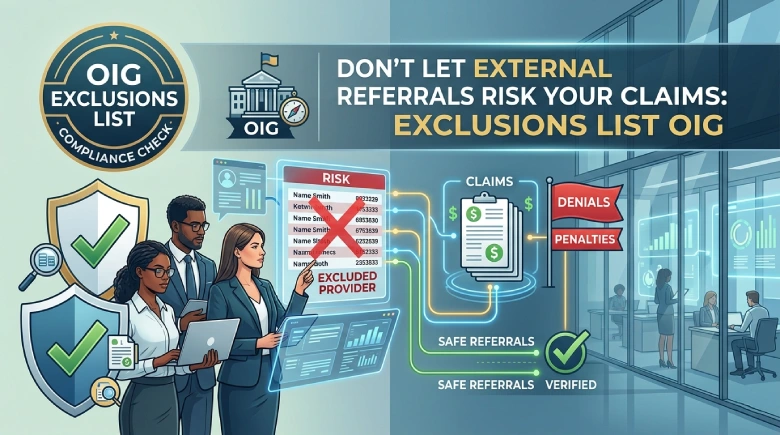
Most healthcare facilities have perfected the process of compliance checks for their own employees by automating the check form exclusions list OIG. Some have even looked at and corrected the loophole involving external vendors, including third parties, and further. However, there is still one external risk that has been hidden or is going unidentified for many healthcare organizations. These include the doctors outside your walls, the one who refers patients, order labs, or write prescriptions. They can make your revenue cycle vulnerable to hefty fines, getting your licenses revoked, or causing reputational damage with just one strike.
While you ensure your payroll is clean through a perfected compliance check system. These entities from the exclusions list OIG can ruin the whole game, introducing chaos, fear, fines, and people’s distrust towards big organizations. Especially in the healthcare industry, one-sided ignorance and mistakes can undermine years of operations and trust-building between people. In this blog, we will explore entities that pose a high risk to large organizations. As checking and screening your own staff against the OIG exclusion list is only half the battle won.
How Do These Tainted Orders Slip Through Organizations?
Even after identifying or understanding this, it becomes the most difficult to manage due to the compliance gap. However, if you bill Medicaid or Medicare for services ordered by an external provider whose name is on the exclusions list OIG, it results in immediate claim denial and potential fines. Therefore, managing the missed compliance gap is vital. Unlike employees, organizations do not possess the SSNs or personal data of referring doctors, making manual verification nearly impossible. Let’s check out some of the common vulnerabilities that come through these individuals.
1. Pharmacy Prescription
Pharmacy prescription records have the highest gap in checks, as they focus on medical necessity and drug safety. It allows them to dispense prescribed medication without checking the doctor’s exclusion status, creating a gap in vulnerability. However, if the prescribing doctor is OIG excluded, the pharmacy’s claim for payment after dispensing medication to the user becomes unpayable. It creates financial loss and compliance risk for the pharmacy.
2. Diagnostic Imaging
The second-most vulnerable department in healthcare is radiology, which receives thousands of orders daily. The requests for X-rays, MRIs, and CT scans, and all these orders came from physicians. Without automated filters on orders, orders from excluded physicians are processed. Imaging is performed, billed, and later rejected, resulting in waste of resources, technician time, machine use, and consumables, yet claims are denied. For that reason, the complaint team must retroactively identify and correct these errors, which is a costly process.
3. Home Health Certifications
The professional providing home health services to patients, most often a physician, must certify the patient’s plan of care. Furthermore, an OIG exclusion must be obtained for these physicians. So the certification, which is the legal basis for billing Medicare and Medicaid, can be processed. Because if physicians are excluded for the entire period of care (weeks or months of services). That account works for thousands of dollars, and it all becomes non-reimbursable. The loss of innumerable agencies delivering care, staff time, and supplies is unrecoverable. Besides, it exposes the agency to compliance penalties also.
4. Laboratory Panels
Labs processed the high volumes of blood work, and physicians ordered diagnostic panels. Without exclusions screening of these physicians, if the order has been processed and completed. The claims are denied, and compliance audits may flag systemic failures. These occur because orders are often electronic and automated, and labs rarely verify providers’ status at intake due to sheer volume. As a result, labs have to absorb costs for reagents, technical labor, and reporting.
Financial Impact Statistics of Missed External Exclusions
The penalty charged for a missed OIG exclusion is often a significant amount for health care facilities. As it included the labour costs, resources used, and many other facilities, rather than the doctor’s visit fee. The exclusion screening is vital for a physician’s prescription or referral, as it affects every service the doctor authorizes. Here’s the table comparison of the liability scope between internal and external risks.
| Risk Category | Source of Liability | Financial Consequence |
|---|---|---|
| Direct Employment | Hiring a nurse found on the Exclusions List of the OIG. | Repayment of that employee’s salary/benefits + CMP fines. |
| Referral/Order | Accepting an MRI order from an excluded doctor. | Repayment of the MRI, contrast, and tech fees + potential False Claims Act liability. |
| Vendor Services | Using a billing service with an excluded manager. | Potential repayment of all claims processed by that manager. |
Concluding Here!
Compliance is an ecosystem, and to maintain it, exclusions list OIG, and checking run through them are imperative for healthcare facilities. However, it’s not limited to healthcare facilities but also required in finance, tech, and many other industries, though its criticality in healthcare is at a high level. Having a compliance ecosystem across any industry protects organisations and the people within them. While you can’t control who refers patients to your facility, you must decide whether you submit claims based on their orders.
Therefore, do not neglect any prescriptions and referrals. Get your Compliance team checks system to run the check against the exclusion list OIG. To secure your claim, as even a single match can invalidate high-clause claims such as surgeries or long-term therapies. To do it even more effectively, integrate the Venops automated compliance system services. We can make your compliance checks easy, fast, and automated, removing hurdles and complexities.
FAQs
If the referring physician is on the exclusion list, can we still treat the patient?
Yes, you surely can treat the patients, but you cannot bill federal health care programs for those services. Any claim made for such services will be denied if the referring physician is on the exclusion list OIG.
How often does the OIG system update its data on excluded entities?
The OIG exclusion list is updated on a monthly basis. It’s imperative to run a compliance check after a monthly interval to prevent the risk of any excluded claims.
Can Venops integrate with our current billing software to catch these risks?
Absolutely! Our solution offers seamless API integration that runs background checks for OIG excluded entities through your referred NPIs. Without interrupting your workflow, and ensuring you never process an order from a banned provider.
Does Venops Catch exclude those who haven’t yet made the federal list?
Yes. We have an advanced, trained system that aggregates data from Medicaid lists to identify potential exclusions for an individual. Exclusions operate at the state level, so they can be caught before they hit federal databases.