Most of the organizations in the healthcare sector treated the Sunshine Act as a strict output requirement. However, CMS Open Payments is not limited to a once-a-year checklist to be ticked for public view and financial reporting. Due to the misconception that most companies follow, their teams have to spend months aggregating spend data to submit to the federal government. In this stressful situation, they often have to scramble to fix inconsistencies right before deadlines. However, smart companies are using this strategy to get ahead and address inconsistencies earlier. They use these government databases as the “Golden Record” rather than as a compliance requirement.
Using these public databases, they are effectively cleaning their internal data to improve data hygiene. This way, they can conduct quarterly reviews to reconcile records with CMS Open Payments and correct any errors that arise. Without waiting until the deadlines come near to match the information. Therefore, this blog explores how organizations can effectively utilize these resources to maintain data hygiene within healthcare facilities. Reducing risk and operational drag that comes with the once-a-year audit.
How Government Data Is a Hidden Asset for Internal Data Cleaning
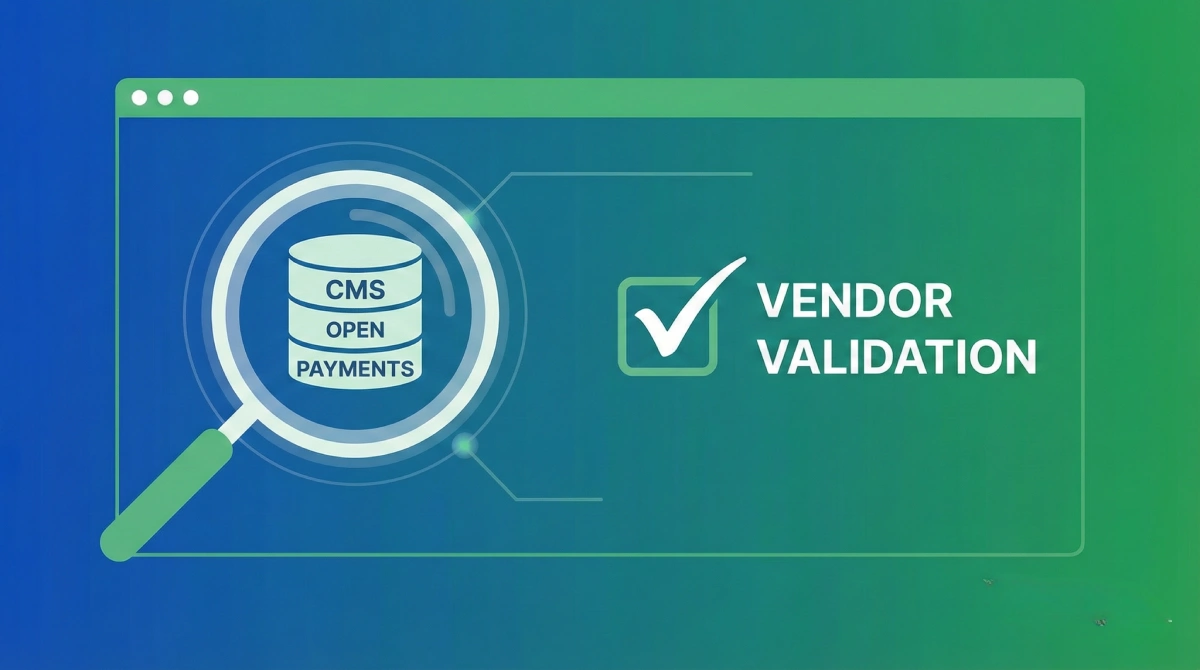
The early data cleansing doesn’t just ensure compliance. It streamlines the entire vendor management lifecycle and reduces the friction and errors that plague accounts payable departments throughout the year. Large datasets on physicians and teaching hospitals are maintained by the Centers for Medicare & Medicaid Services (CMS). This includes the National Provider Identifier (NPI) numbers, state license information, primary specialists, and business addresses. The Open Payments CMS can be used by organizations struggling with data quality issues, such as duplicate vendor profiles or missing taxonomies. These are external database tables that serve as a gold mine, containing all the information needed to match records.
Using the CMS, it becomes easy to fix the error and match the missing portion. If used properly, this can be an ideal, free, high-quality verification tool against messy internal vendor master files. Validating internal records involves conducting a health check of your vendor file in the Open Payments CMS. It helps with the confusion you get when you have three similar names like “Robert Smith,” “Bob Smith,” and “Dr. R. Smith.” To avoid such confusion, you can merge and categorize such names in your vendor field, which will help you enrich your vendor profiles. With verified, standardized data points that are critical for accurate reporting later down the line.
Cross-Referencing Strategies And Validation
To realize the full benefit of this system, the organization needs to implement active protocols, such as quarterly checks. Simply downloading the dataset and matching it once a year during the reporting season is not enough. By targeting it strategically, a team can transform that regulatory requirement into a robust filter that catches errors before they corrupt your Vendor Master File. Here’s how an organization can start with this transformation:
1. Pre-Onboarding Sanity Checks
Before making an entry for a new healthcare provider in your ERP system, check and match their information against the open payments system databases. Which will allow you to capture the exact legal spelling, primary NPI, and taxonomy code immediately, ensuring the “Golden Record” is accurate from day one. Following these will keep it clear and not need to be cleaned up months later.
2. Conduct Quarterly Audits
One of the biggest compliance risks an organization faces when a physician is accidentally onboarded as a standard “Trade” or “consulting” vendor. Causing them to be excluded from reporting logic to avoid such mistakes, run quarterly checks against the CMS dataset to identify such name matches. So you can catch hidden doctors in your supply chain who should be tagged or tracked.
3. Automate Gap Analysis for Missing Data
Internal vendor files are often incomplete, missing critical information such as state license numbers or specialty details. You can use federal databases to fill the gap by performing a gap analysis. This way, you can identify where your internal data is blank and fill those gaps with verified public data.
4. Standardized Address Formats
Address mismatches are often the cause of reporting problems. By checking your vendor address against the location listed in the federal databases, you can maintain your master file. This will make it easier to show the physician’s primary government-recognized business address, reducing the risk of record mismatches during submission.
Summing It Up!
Data integrity is vital to keeping healthcare facilities in check and maintaining their reputation in the market. CMS Open Payments is the backbone of this management, ensuring that the relationship between teaching hospitals and doctors is professional and based solely on financial considerations. However, it is often seen that the organization views it as a burden that takes time and creates maintenance headaches. But doing it properly and on a timely basis generates efficient results. Regulatory compliance is not just a resource drain, as many organizations see it. It can be a great tool for improving internal processes.
By using this Open Payments CMS for validation, you can move from a reactive posture (fixing errors in the last minutes). Into a proactive posture in which your data is clean from the start. However, conducting frequent research can disrupt workers’ workflows and consume significant organizational time. Therefore, the most efficient option is to use Venops‘ services. It is an automated platform that quickly performs checks and maintains the file against federal database lists.
FAQs
Q 1. What exactly is an open payments program of CMS?
Ans: The CMS Open Payments is a federal government program that collects information on certain payments and transaction values. In this, records are maintained from manufacturers of drugs, devices, and biologicals to physicians and teaching hospitals. All of this collected information is presented publicly and publicly available for public view once a year, and the cycle repeats to maintain transparency in the medical sector.
Q 2. What’s the timeline for updates to this Open Payments program?
Ans: The timeline follows the Open Payments Program and the Centers for Medicare & Medicaid Services. It is annual. In which they collect and publish it. The CMS publishes the full dataset for the previous year’s calendar every June. However, updates and disputes can alter the data periodically.
Q 3. Can I use the CMS search tool for individual vendor onboarding?
Ans: Yes. Before creating a new vendor record, the analyst can search the databases to verify the physician’s NPI, specialty, and official spelling. By following this, you can ensure that the new record is created accurately from day one. The clear, clean data will also help with later checking and cleaning of data.
Q 4. Why does our internal data rarely match federal databases?
Ans: The differences between internal data and federal databases often occur because internal data is entered manually by different people over time. Leading to typos and variations from the one maintained by the federal government, as it relies on standardized NPI registries. That’s what makes it more consistent, unlike the internal one.
Q 5. What happens if we fail to report a vendor found in the databases?
Ans: The failure to report payments to a covered receipt can be seen as punishable or fraudulent activity. That can result in significant civil monetary penalties, capped at over $1 million per year for knowing violations.