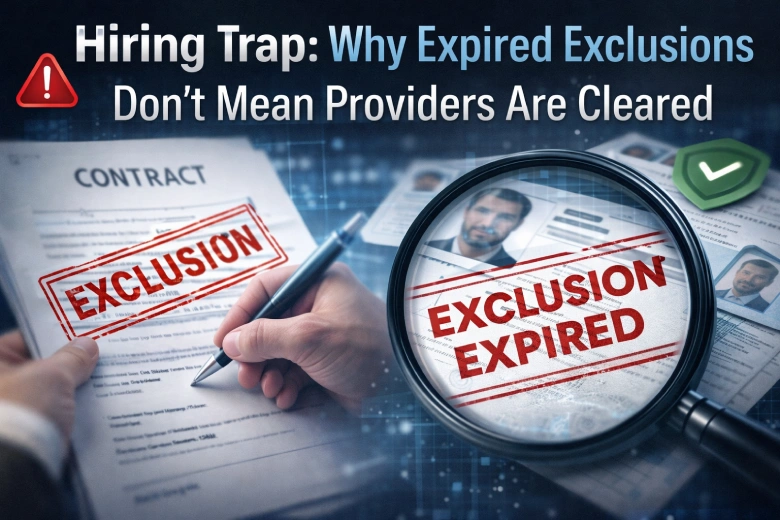
One common mistake in the hiring process is treating a candidate with over 5 years of experience as hireable to HR. When it comes to exclusion screening, the healthcare sector has been highly vigilant to avoid hiring any entity on the OIG excluded list. But over time, when a candidate reaches the 5-year mark, HR often misleads itself into thinking they are safe to hire. However, the OIG screening is still crucial in that situation as well, because the individual isn’t eligible to work. Until they apply for reinstatement and are granted it, only then is an individual free from the OIG exclusion list and hireable.
The blog explores the criticality of hiring an entity that has passed the exclusionary period of up to 5 years. The guide will help you understand the reinstatement myth and the penalties that an organization has to follow. It is vital for the hiring manager to follow the facts, not the myths.
Why Reinstatement is Administrative, Not Automatic
The OIG exclusion doesn’t possess an expiration date like a carton of milk. If you, as a hiring manager or organizational member, hire an individual solely based on the calendar, your practice is immediately liable for CMPs. Civil Monetary Penalties (CMPs) are the financial fines and charges imposed by federal government organizations, such as the OIG, SEC, or FDIC. It strips away any economic benefit gained from misconduct, encourages stronger compliance programs, and, in some cases, helps compensate victims or fund corrective initiatives. Therefore, it is essential for an excluded entity to reapply and pass the OIG screening before starting their employment.
Assuming safety is bound to put the organization in a financial crisis, which is certain to cause risk. Hiring managers must be aware of it and conduct the OIG screening with sincerity. Therefore, it is crucial to understand that the LEIE (List of Excluded Individuals/Entities) is not self-cleaning. It remains on the list until someone applies it, and the OIG makes a specific decision to remove it. The responsibility of applying for a reinstatement is entirely dependent on the excluded individual. If they forget to do so or assume they are clear on their own, they remain radioactive to the payroll system of an organization.
Timeline Gap: Between Applying And Granting Reinstatement
Having an automated system for OIG screening can save your healthcare practice between the time frames that confuse HR. The first checkpoint is the Limbo period, during which the candidate has applied for reinstatement, but it hasn’t been granted. The process often requires 120 days or longer before the name of the excluded individual is removed from the exclusion list. In this timeframe, the employer gets confused and hires a candidate, as an excluded entity might honestly tell the employer. They said they have already sent the paperwork. However, the “pending reinstatement” = “still excluded.” Don’t get confused by these terms, as it will put your organization in a dangerous position.
The only thing that matters in such a situation is the official documentation. The official written notice from the OIG clarifying that someone has been reinstated. Without that piece of paper, verbal communication is unreliable, and a clean state license is irrelevant to actual billing.
How Venops Automates the Truth
The annual check is already a very slow process and is prone to human error. However, the risk increases when it comes to calculating dates in your head and determining whether the excluded entity is reliable to work with. Venops is an automated platform that provides services to many healthcare finance sectors and performs automated checks across multiple government lists. It’s a fast system that generates results in a few minutes. Partnering with Venops will prove a profitable investment that will deliver better ROI in the long term.
Venops Advantage:
Venops doesn’t just check once at the time of hiring. It also provides monthly automatic checks. If a reinstatement didn’t go through, Venops flags it and will alert you immediately.
Venops is a reliable partner that performs cross-reference checks. We check LEIE with SAM.gov and state Medicaid lists to ensure that an issue in another area hasn’t blocked a reinstatement in one area.
Partnering with Venops has so far saved many clients from getting exposed to federal penalties. Additionally, the time that employers would have spent on manual checks. With Venops, you are in completely safe hands with our platform and services. You can even automate the check to receive a personalised result at a specified interval, without delay.
Summing It Up!
The timeframe creates confusion in the head of the hiring manager, sometimes resulting in space penalties and fines. Which results in the organization facing penalties and fines that can be avoided with an understanding of the reinstatement process and its timeline. It is especially critical for employers to understand so they don’t make such mistakes and protect their organizations. Even for an individual undergoing OIG Screening and being perfectly cleared, having guaranteed documentation is better.
It is better to automate with Venops and be tension-free from this process, as Venops will handle all of it for you. The onboarding time is also very short, so that you can start the OIG Screening immediately.
FAQs
Is OIG reinstatement automatic after the exclusion term ends?
No. The OIG does not automatically remove the individual’s name even after the exclusion period ends. Even if the exclusion period (e.g., 5 years) has passed, the individual remains on the LEIE until theysubmitt a written request and receive official notice of reinstatement. Hiring any individual before they receive their official letter from OIG puts your organization at risk of penalties and fines.
What’s the timeframe of the reinstatement process, and how long does it usually take?
The reinstatement process typically takes at least 120 days, but it can drag on much longer depending on the case’s complexity. The OIG advises excluded individuals not to submit their requests too early. During the process period, when an individual has applied and is still on the pending list, the excluded entity remains excluded. As processing operiods is treated as excluded periods as well. You cannot employ them in any federally funded capacity until the process is fully complete.
Can we hire aprovider who is “pending” reinstatement?
No. If an individual is in the reinstatement process, you cannot hire them, as the federal program treats such individuals as excluded entities. Any involvement with the theme can expose your organization to penalties. Employing them during this “pending” phase is a violation. You must wait for the official to clear their name and remove them from the LEIE database.
Does having a valid state license prove reinstatement?
Not necessarily. A state medical board might restore the license, but it is separate from the federal OIG exclusion. The OIG has its own distinct authority. Possession of a valid state license does not prove that a federal exclusion has been lifted. It is necessary to identify separately against the OIG LEIE.
How does Venops help businesses hire non-reinstated staff?
Venops uses an intelligent algorithm to continuously monitor federal and state databases. We don’t just look for matches. We also help verify any possible matches. Along with this, we help verify whether a “past” exclusion is actually resolved or not. Our automated systems alert you immediately if a current employee or vendor is on an exclusion list. Preventing costly oversight and ensuring total compliance.