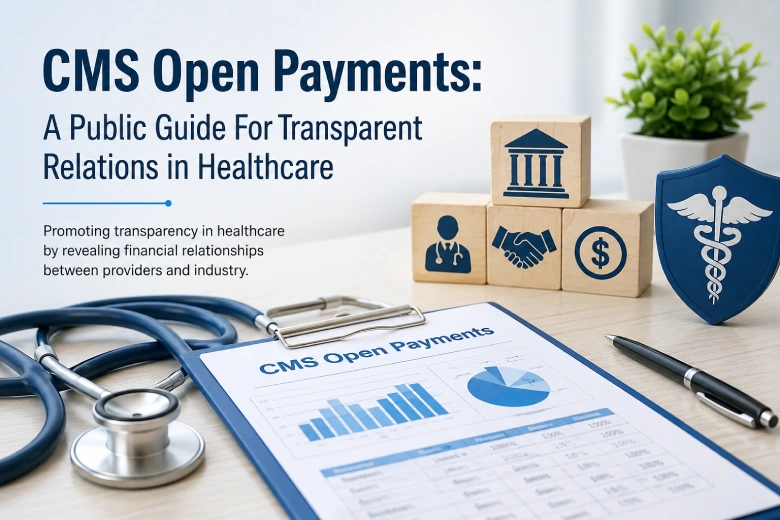
The Physician Payments Sunshine Act, launched in 2013 designed to look after CMS Open Payments to inform the public about the financial transaction. Between healthcare organizations or facilities and the people they partner with, from healthcare companies to doctors, physicians, and hospitals. In the last eight years, this system has had total payments disclosures exceeding $90 billion, with $14.67 billion. Those were the statistics in disclosures made in the year 2025. With the purpose of transparency and prevention of conflict of interest in mind, the act has proved to be a success.
Under the act, medical device companies, drug makers, and GPOs, referred to as reporting entities, have to make reports about payments. Whether it was made to doctors, teaching hospitals, and various other covered recipients in the health sector. The recording of these payments is done using the CMS Open Payments program. Nevertheless, this blog provides guidance that helps you understand this Open Payments system and how to send and report payments effectively. It will save you a lot of time and trouble. Let’s see how it’s done.
What Is CMS Open Payments?
CMS Open Payments is a transparency initiative run by the Centers for Medicare & Medicaid Services (CMS). It acts as a tool for enforcing the Sunshine Act by ensuring covered companies file reports about payments and transfers of value. Furthermore, even about ownership interests in order to comply with the law. The goal of Open Payments CMS is to gather information about the movement of money. Between pharmaceutical companies and healthcare providers, including teaching hospitals.
As soon as the data is gathered for each calendar year, the CMS releases the data via its website. Not later than June 30 of each year, in addition, the CMS updates the Open Payments database annually each January.
Who Needs to Report Transactions & What Is Reported?
In accordance with the Sunshine Act, certain organizations have a legal obligation to document payments, gifts, or any transfer of value. That is offered to healthcare professionals for reporting to Open Payments CMS. The law clearly distinguishes between “reporting entities” (organizations making payments or gifts) and “covered recipients” (healthcare professionals or institutions receiving them). Knowing who belongs to which category will help you meet the requirements set forth by the law.
In the table below, we will look at the list of organizations that have to report and what kind of healthcare professionals and institutions they have to report about.
| Classification | Classification Of All Organizations And Individuals |
|---|---|
| Reporting Entities | Group purchasing organizations, Pharmaceutical companies, Medical device manufacturers |
| Covered Recipients | Physicians, teaching hospitals, non-physician practitioners, Physician assistants, Certified registered nurse anesthetists, Anesthesiologist assistants, Certified nurse midwives, Nurse practitioners, Clinical nurse specialists |
What Is Being Reported?
Whenever a reporting entity offers some kind of wealth transfer to a covered recipient, this information has to be reported. Venops, as a compliant software, can help you manage and effectively run this system without error. According to experts, it is best to be on the safe side and report everything, because otherwise the financial consequences of such an omission could reach $176,000 if it was unintentional and $1.176 million if it was knowingly done. You can never be fined for “over-reporting,” but submitting expenses that don’t need to be reported will only make your dispute process more complicated.
In the table below, we will outline the three major categories of reportable payments alongside the specific, day-to-day financial situations that require reporting.
| Major Reporting Categories | Specific Situation Names And System Terms |
|---|---|
| General Payments | Medical education, Consulting, Gifting of any kind, Guest speaking compensation |
| Research Payments | Entertainment, Food and beverage, Travel and lodging, Debt forgiveness, Grants |
| Ownership And Investment Interests | Physician ownership, Immediate family member ownership, Immediate family member investment interests, Long-term loans, Royalties and licenses, Charitable contributions, Transfer of wealth |
| Reporting Systems | Centers for Medicare and Medicaid Services Open Payments, Financial harm, Unnecessary expenses, Lack of reporting, Lengthy dispute periods, Hiccups in the dispute process, Silver lining |
| Penalty Amounts | Fine of up to one million one hundred seventy-six thousand dollars, Fine of one hundred seventy-six thousand dollars exactly |
Step-by-Step Guidance For Report Submission to CMS
Even though Open Payments demands meticulous record keeping throughout the year on the part of the physician. Venops eases the compliance process by providing automated exclusion checking and vendor surveillance functions. The payments of all reporting entities need to be tracked from January 1 through December 31. That is referred to as the data collection period.
For the reporting entities, the submission period is from February 1 to March 31. This provides all reporting entities three months to go through their payment data and provide accurate data to the Open Payments CMS platform. If a reporting entity has its payment data ready to submit to the CMS, then it is quite an easy process:
- Step 1: Log into the CMS Enterprise Portal.
- Step 2: Log in using your credentials.
- Step 3: Choose manual or bulk file upload from the submissions tab.
- Step 4: Input your data or upload a ZIP or CSV file.
- Step 5: Recheck to ensure that you have uploaded the right file or data.
- Step 6: Submit the information.
- Step 7: Complete the attestation process, as it ensures that you are submitting truthful documents.
Concluding Note!
The CMS Open Payments program shapes the healthcare industry in many ways and ensures it always stays trustworthy. The reimbursements, rulemaking, reporting, and the physicians’ fee schedule are constantly changing in these rapid modern times. It is essential for healthcare industries or organizations to stay compliant without fail or delay. Therefore, consistently following up with the changes and new rules is the only way to stay compliant with the law.
While the Open Payments CMS website itself provides all the crucial information and the changes made in the databases. It is necessary to partner with a platform like Venops to ensure all your data is centralized and continuously monitored. So there is no room for errors, and your organization can avoid hefty penalties or fines from the government. With us, ensure your team knows the law, keep your staff informed, and make open payments daily part of your business operations.
FAQs
Are there any consequences of non-compliance?
Yes. Intentional neglect to report the transfers results in fines up to $1.176 million. Even unintentional failure to submit will cost your company $176,000 in fines, so always be safe than sorry.
Who qualifies for a covered recipient?
What kind of services does Venops offer?
Venops offers automated solutions for compliance within healthcare organizations. Continuous OIG exclusion screening, primary source verification, and full vendor management are the strengths of our company that help you avoid fines.
Why choose Venops for exclusion screening?
Venops automates the time-consuming process of background checks in federal and state government resources. It ensures continuous vendor and staff monitoring in order to protect your healthcare organization from fines.
What makes Venops the best option for Sunshine Act compliance?
Venops, as a compliant platform, automates open payments tracking by centralizing all your data in one place. Therefore, you will have all the information regarding financial transactions in one place, making it easy to track. With Venops, you don’t have to worry about manual mistakes and CMS penalties.